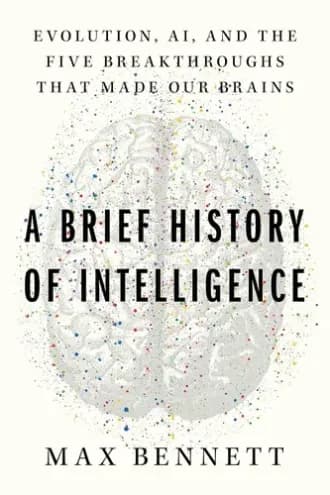
A Brief History of Intelligence
Read: 2026-01-27
A Brief History of Intelligence is a window into the last 100 million years of human evolution, specifically focusing on the brain and AI.
Bennett distills the millennia into the large evolutionary breakthroughs that have resulted in the intelligence of humans. Despite the research that has taken place by anthropologists, neuroscientists, biologists, AI researchers, and more, there are still a plethora of unanswered questions that the book leaves. This is not a fault of Bennett, but rather an observation of how much the industry still needs to understand.
Here are some of the most pressing questions that have lingered with me after reading the book:
How do animals learn so efficiently? Sure, AI systems have been able to comprehend vast amounts of knowledge, but they've done so with petabytes of data, and zettaflops of compute, and megawatts of power. Humans have the ability to learn at a supremely more sample-efficient rate, begging the question of how it's possible from a technical perspective.
Are the measures and experiments that we use to evaluate animal intelligence wholly insufficient to measure artificial intelligence? Given their massive quantities of training data and ability to learn workarounds to experiments meant to test them, will it even be possible to measure their capabilities on the same axes as humans? Will we need to scale down models to effectively test these levels of intelligence? But is their whole essence of intelligence scale?
This book was deeply insightful and leaves the reader searching for answers to intrinsic philosophical questions. Maybe we'll be able to learn from these systems just as they've learned from us.